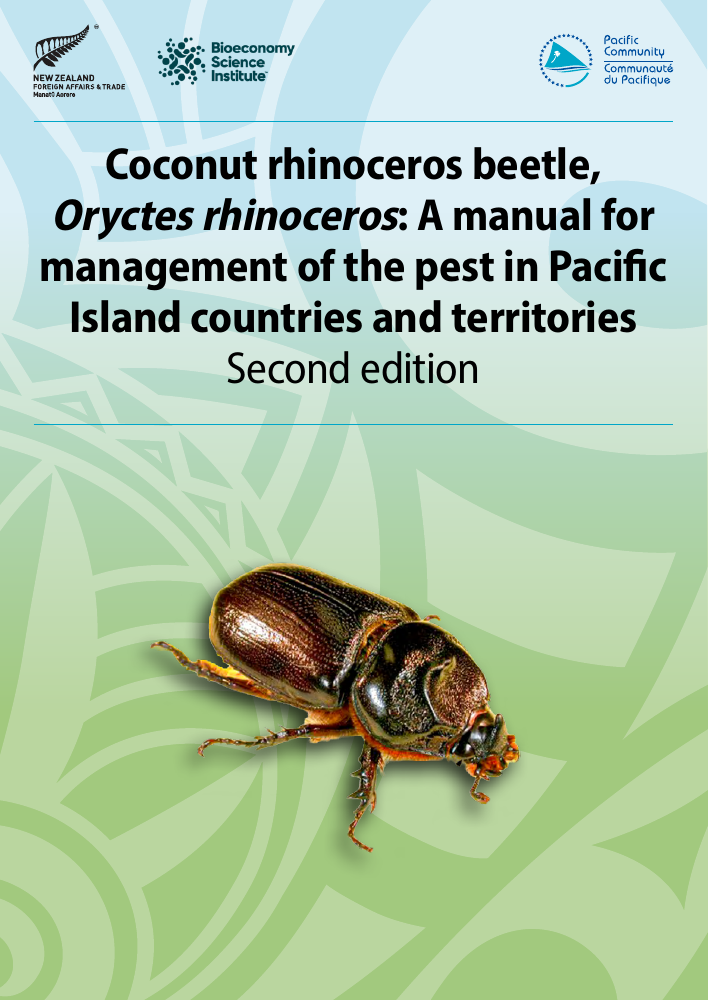
The Pacific Community’s second edition brings identification, monitoring, sanitation, biological control, and integrated pest management together. Our reading guide takes you to the relevant pages.
Uses occurrence records and selected environmental variables in a MaxEnt model to explore global habitat suitability for CRB. The authors compare current conditions with three climate scenarios for the 2050s and 2090s.
Combines occurrence records, bioclimatic variables and elevation in a boosted regression tree model to estimate potential CRB habitat. It compares present suitability with two climate scenarios for 2030, 2050 and 2080, providing a basis for discussing surveillance priorities.
A field study compared Bacillus thuringiensis, Metarhizium robertsii and M. majus, alone and in combinations. Combined treatments produced greater larval mortality in the tested conditions.
Tests three native insect-parasitic nematode isolates against second-instar CRB larvae in laboratory experiments in India. Mortality varied with nematode species, exposure and dose; the study identifies candidates for further evaluation.
Develops a genetic identification approach for Oryctes rhinoceros nudivirus isolates. Comparing selected genome regions and sequencing amplified fragments helps distinguish isolates and provides tools for tracking virus identity in biocontrol research.
Examines South Pacific CRB populations and nudivirus occurrence. Infection appeared in multiple haplotypes, and mitochondrial labels were not reliable substitutes for biological traits.
Examines nuclear and mitochondrial genetic variation to investigate Pacific CRB invasion pathways, and highlights limits to resolving those pathways from the tested markers.
Reviews the introduction and establishment of Oryctes virus in Pacific beetle populations and the historical reductions in feeding, reproduction and palm damage. It also discusses renewed damage in some locations and the need to investigate strains and application methods.
Compares management modules in young coconut plantings after Cyclone Gaja in Tamil Nadu. The integrated module recorded less shoot damage than the compared farmer practice.
Reviews CRB development, habitat, introduction and establishment as an oil-palm pest in Malaysia. It traces changes in research and management approaches as growers sought to understand and control damage to young palms.
Tests the composition and plant-growth effects of frass from captive CRB larvae fed cocopeat. Arabidopsis growth improved in tested amended substrates.
Compares CRB populations in Malaysian oil-palm and coconut plantings and associations with rainfall. More beetles were recorded in the sampled oil-palm setting.
Discusses how fuller use of coconut by-products could support food security and value creation in Sri Lanka. The chapter considers materials such as testa, shell, inflorescence sap and mature coconut water within the wider coconut economy.
Wider context · Other organisms, crops or coconut knowledgeRead the study guide 2017 / Coconut ecology & knowledge
Draws on surveys across 27 Pacific islands to discuss traditional coconut-variety conservation and Polymotu, using geographic isolation to conserve planting material.
Wider context · Other organisms, crops or coconut knowledgeRead the study guide 2011 / Coconut ecology & knowledge
A Pacific coconut profile covering botany, varieties, growing conditions, propagation, uses, products and agroforestry. It connects coconut cultivation with the many roles of the palm in island communities and gives a substantial bibliography for further reading.
Wider context · Other organisms, crops or coconut knowledgeRead the study guide 2004 / Coconut ecology & knowledge
An early experimental paper investigating expression of a fluorescent reporter from recombinant DNA in coconut water. The author explores potential uses of coconut tissue in biotechnology and protein-production research.
Wider context · Other organisms, crops or coconut knowledgeRead the study guide 1996 / Coconut ecology & knowledge
A technical handbook on coconut timber, from the properties of the stem through processing, grading, drying, product design, economics and marketing. It restores the original library’s missing handbook reference to the complete edition hosted by FAO.
This collection carries forward verified research from Aloha Organic’s original library. Each reading page identifies what was studied and where. Studies on other insects or crops are marked as wider context. Full text is available here when the publisher’s access and reuse terms allow; otherwise the reading guide links to the original publication.