Look closely. Learn the difference.
A visual starting point for identifying coconut rhinoceros beetle and the signs it leaves behind.
From egg to adult.
See how the beetle changes, and where to look at each stage.
02 / DAMAGE SIGNSLook at the crown.
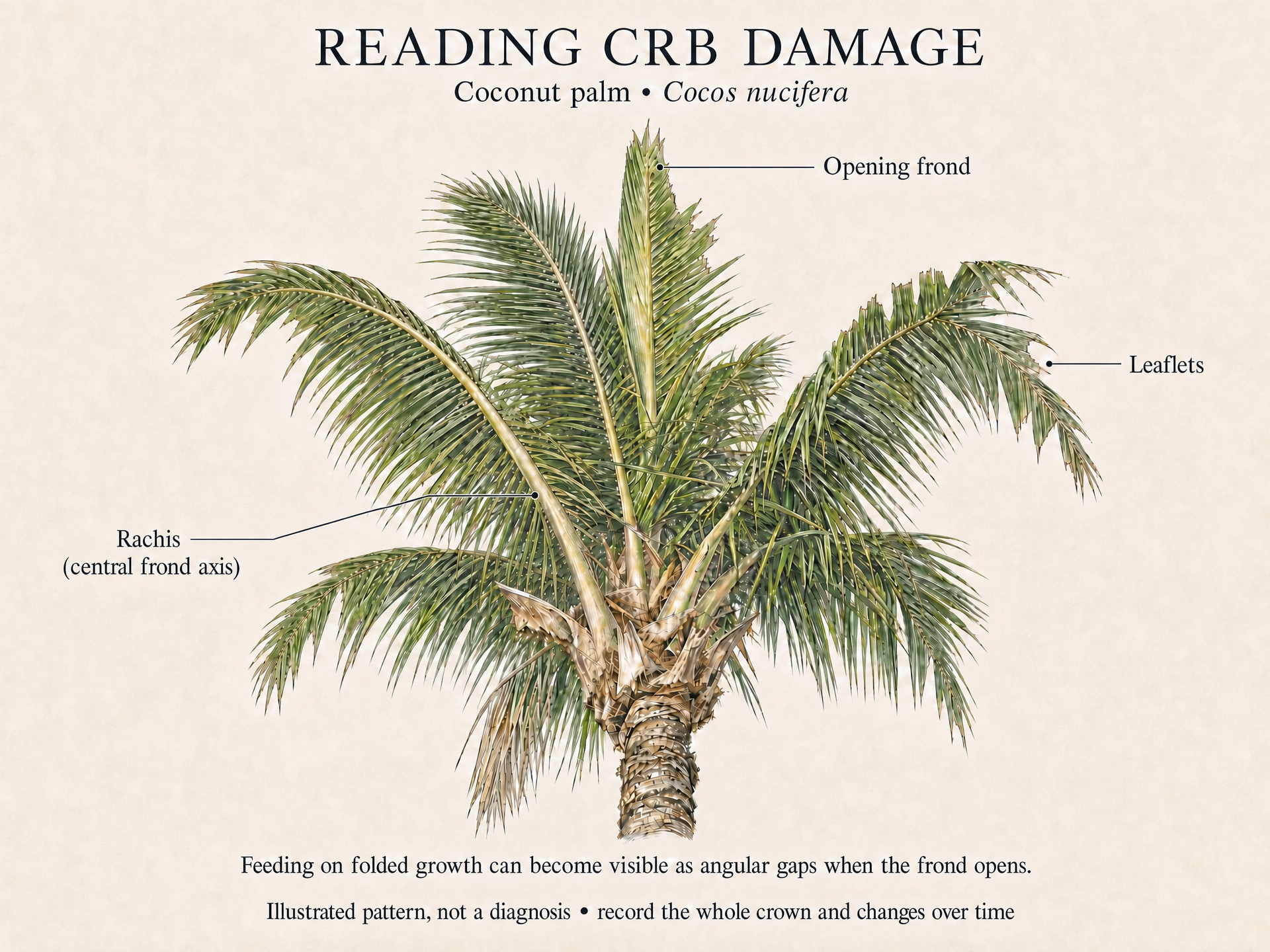
Compare notched leaves, bore holes, and canopy decline.
03 / LOOK-ALIKESSimilar is not the same.
Compare larvae and record details that help with identification.
Begin with
a closer look.
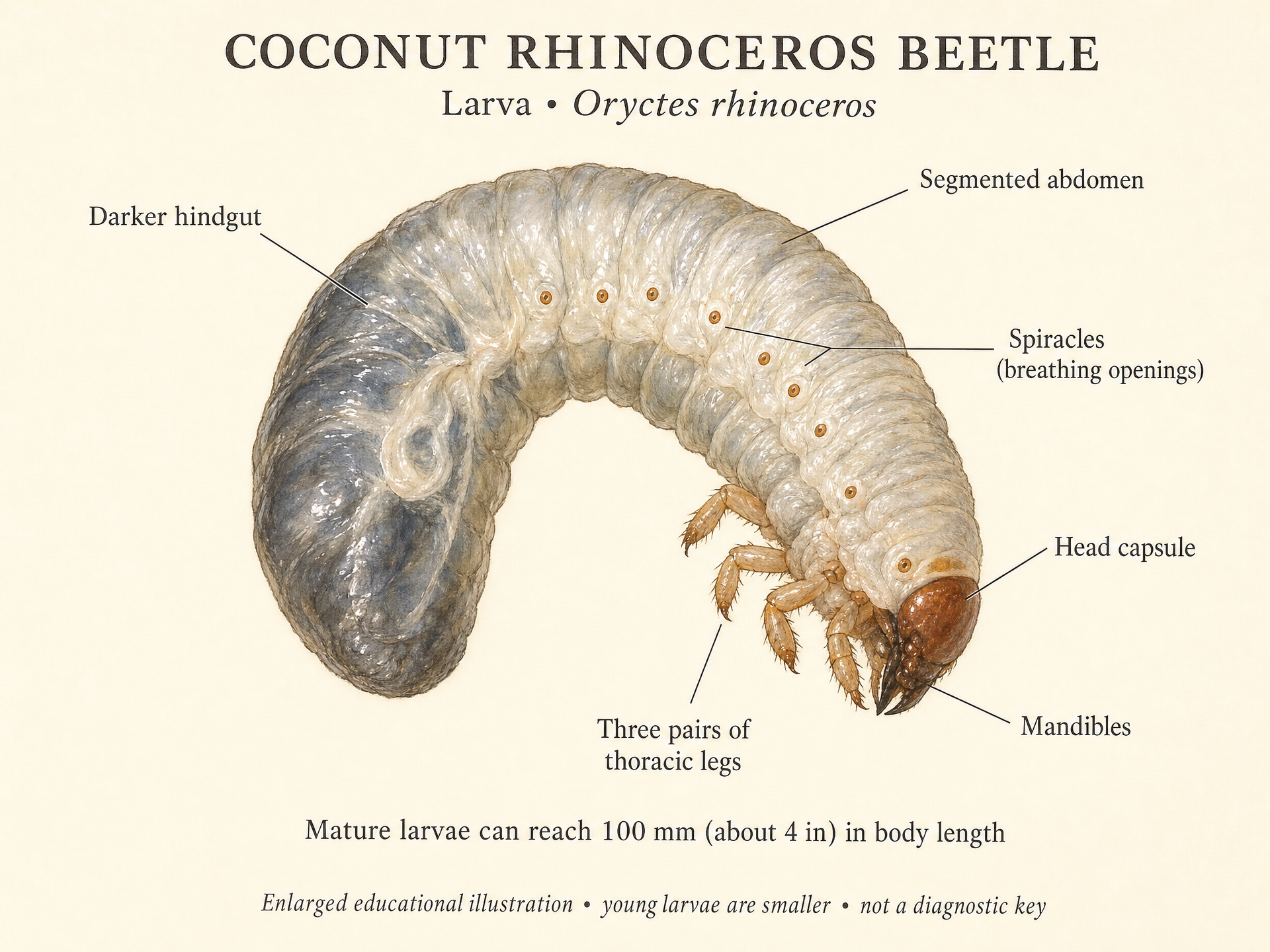
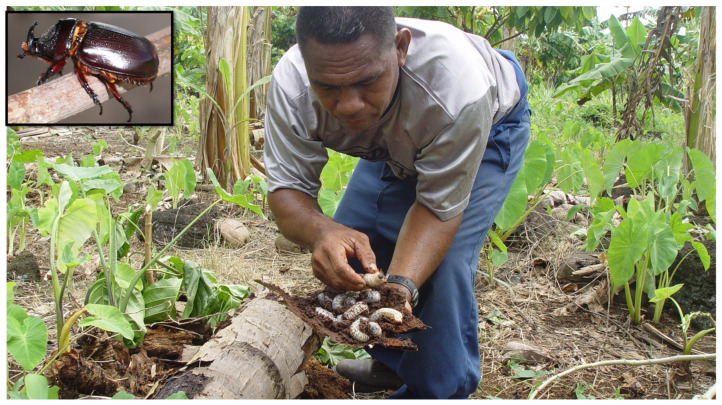
Oryctes rhinoceros is the coconut rhinoceros beetle. Adults are dark, horned beetles, typically around two inches long. Larvae are pale grubs that curl into a C shape.
Record size, shape, movement, and the material where you found the insect. A clear photograph with a ruler is more useful than a guess from color alone.
Make an observation recordSources & reading notes
Reviewed October 22, 2026. Aloha Organic summaries draw on the sources below.
Recognize the adult form.
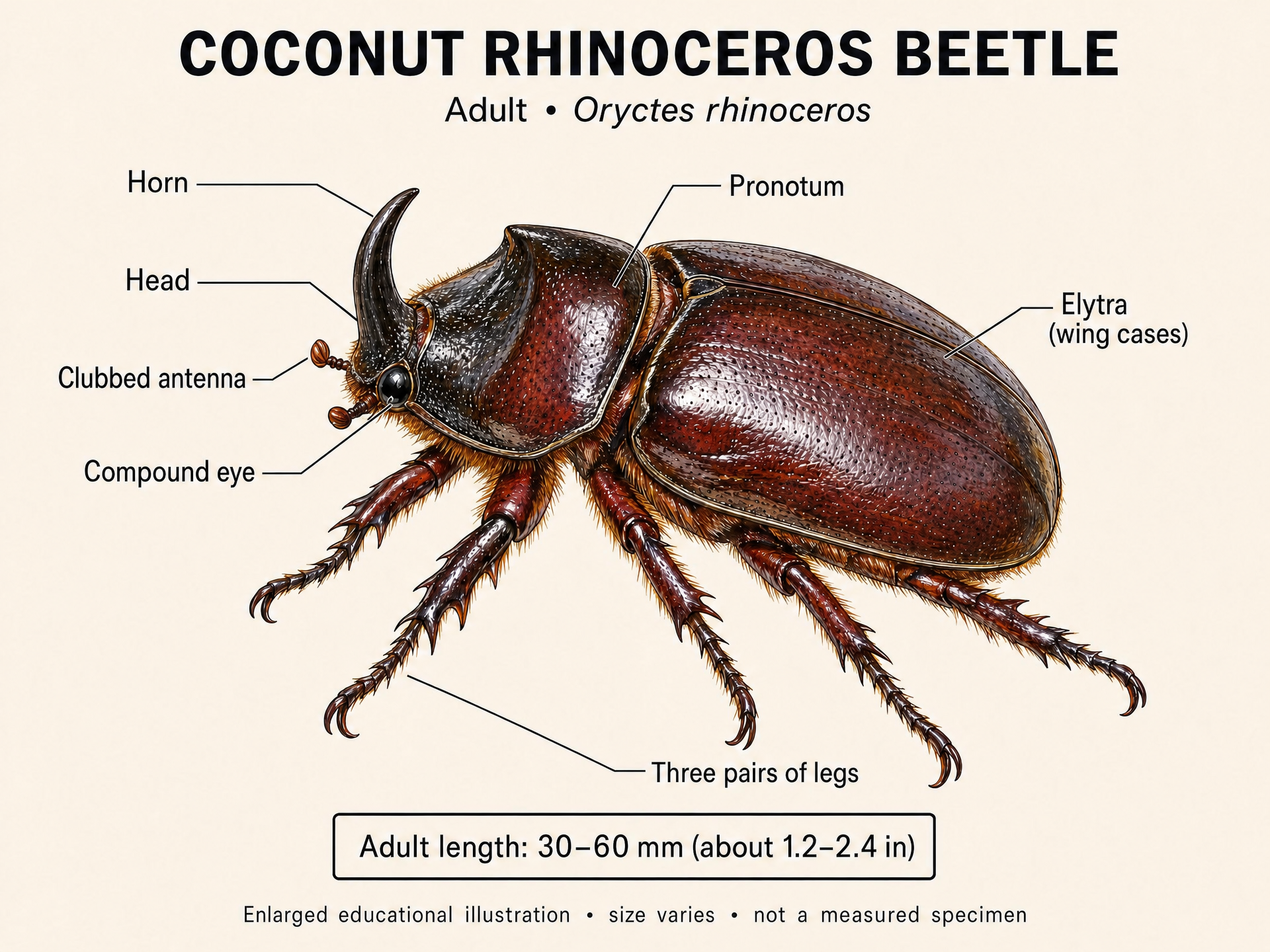
What each part tells you.
Open a label for a plain-language explanation.
Horn
A single horn rises from the head. Both sexes have one; horn length alone is not a reliable way to determine sex.
Head
The front body region carries the horn, antennae, eyes and mouthparts.
Clubbed antennae
The short sensory antennae end in a club of leaf-like plates, called lamellae.
Compound eyes
The eyes sit at the sides of the head. Each is composed of many small visual units.
Pronotum
The large shield immediately behind the head covers the first segment of the thorax.
Elytra · wing cases
The paired hardened forewings protect the folded flight wings and the body beneath.
Three pairs of legs
All six legs attach to the thorax. Perspective can hide far-side legs; this drawing is not an underside identification key.
Anatomy and size reference: SPC manual, chapter 2 . Generated educational interpretations are shown beside real reference photographs.
Compare the lengths.
Adult body length is 30–60 mm. Mature larvae can reach 100 mm along the body; younger larvae are smaller.
The solid adult bar reaches 30 mm; its striped extension reaches 60 mm. Both bars share one relative scale. This graphic is not a physical on-screen ruler, and the enlarged illustrations are not to scale. Larval length follows the body, not the width of its C-shaped pose.
Source: SPC second-edition manual, printed pages 5–7. Photograph a ruler beside a real specimen when recording size; size alone does not confirm CRB.
One head hornBoth sexes have a horn. Its size varies; a horn alone does not identify sex.
A robust, dark bodyAdult body length varies, commonly 30–60 mm in the SPC manual. Record a size reference with a real specimen photograph.
Observe several featuresCompare body shape, head and wing covers with photographs. An illustration is a learning aid, not a specimen record.