
One beetle. Four life stages.
Connect what you find with the stage of the beetle’s life cycle.
Each illustration is enlarged independently, not shown on a shared scale. Open a plate to see its labels at full size. Illustrations explain life stages; they do not confirm a specimen’s identity.
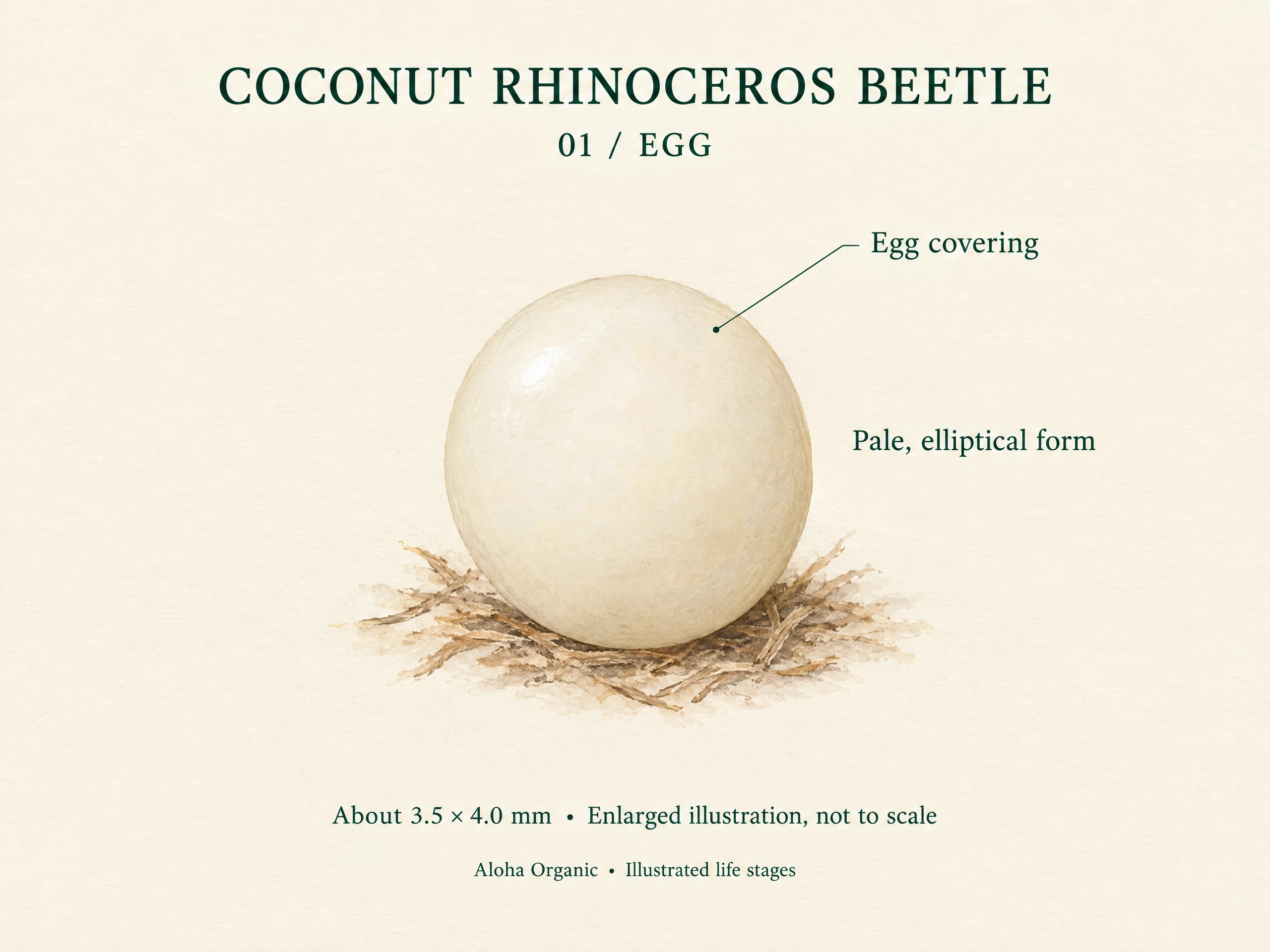
Egg
The cycle begins in breeding material.
Eggs are laid individually in decomposing organic material. Their pale, elliptical form is easy to overlook among the fibers.
- What to notice
- A smooth, whitish covering and a nearly round, elliptical outline.
- Size context
- About 3.5 × 4.0 mm in the SPC manual—only a few millimeters across.
Larva
A feeding grub in decomposing material.
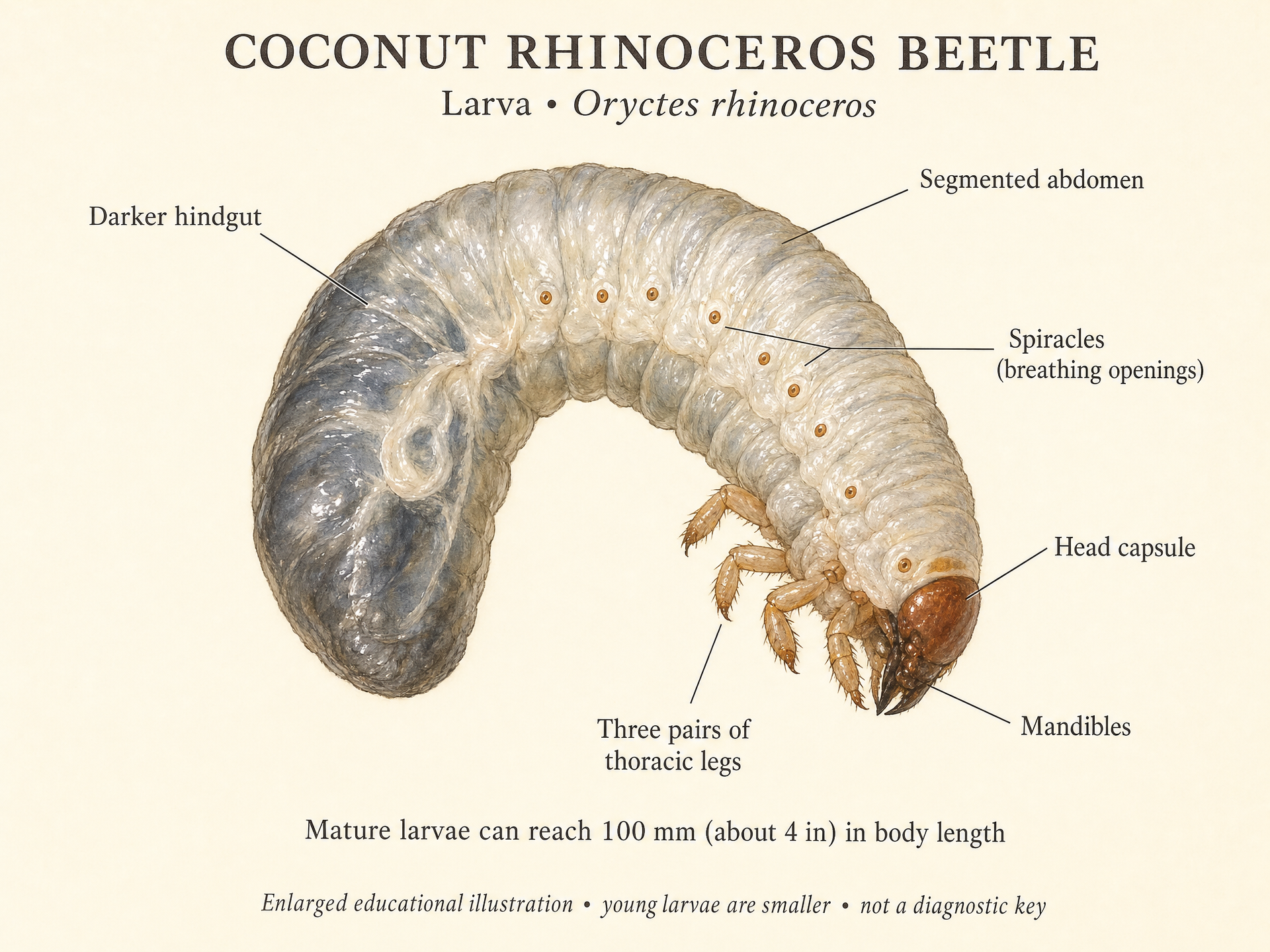
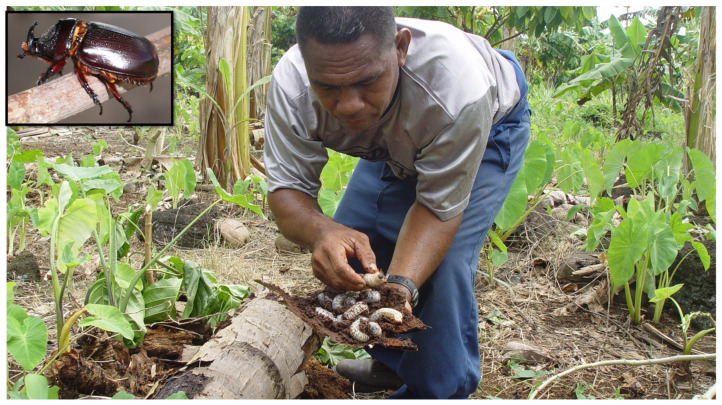
The larva feeds and grows through three instars before pupating. Its curved body is very different from the adult beetle.
- Parts to compare
- Brown head and mouthparts; three pairs of legs behind the head; a pale, segmented abdomen.
- Size context
- Mature third-instar larvae may reach about 100 mm (4 inches). Younger larvae are smaller; size alone does not identify CRB.

Pupa
The adult form takes shape.
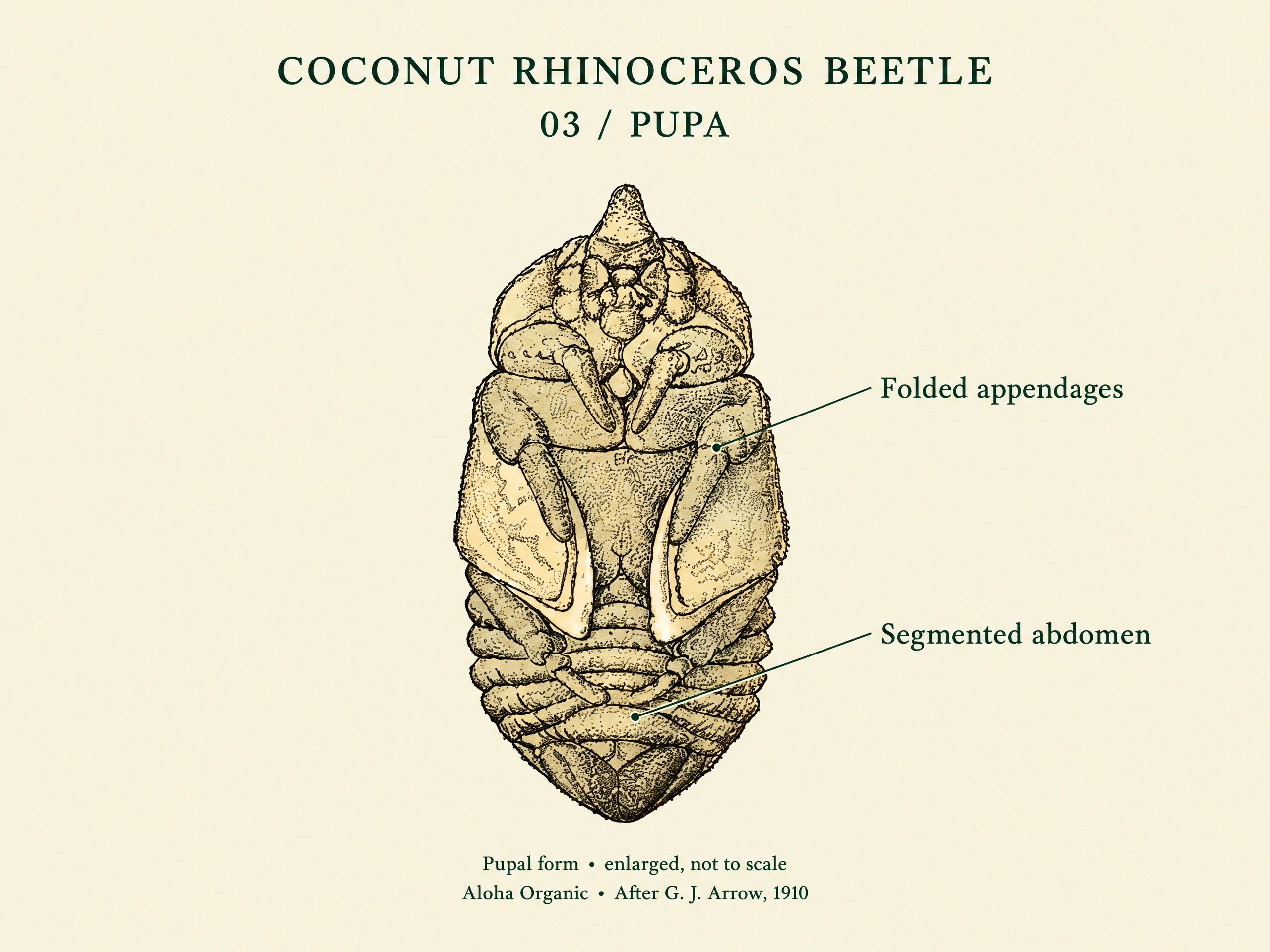
Within a pupal cell in the breeding material, the insect changes into an adult. Developing appendages lie folded close to the body.
- Parts to compare
- The developing head horn, folded legs and wing cases, and segmented abdomen.
- Read the view
- This ventral view shows the underside of the pupa. It is not a walking adult or a butterfly chrysalis.

Adult
A flying, night-active beetle.
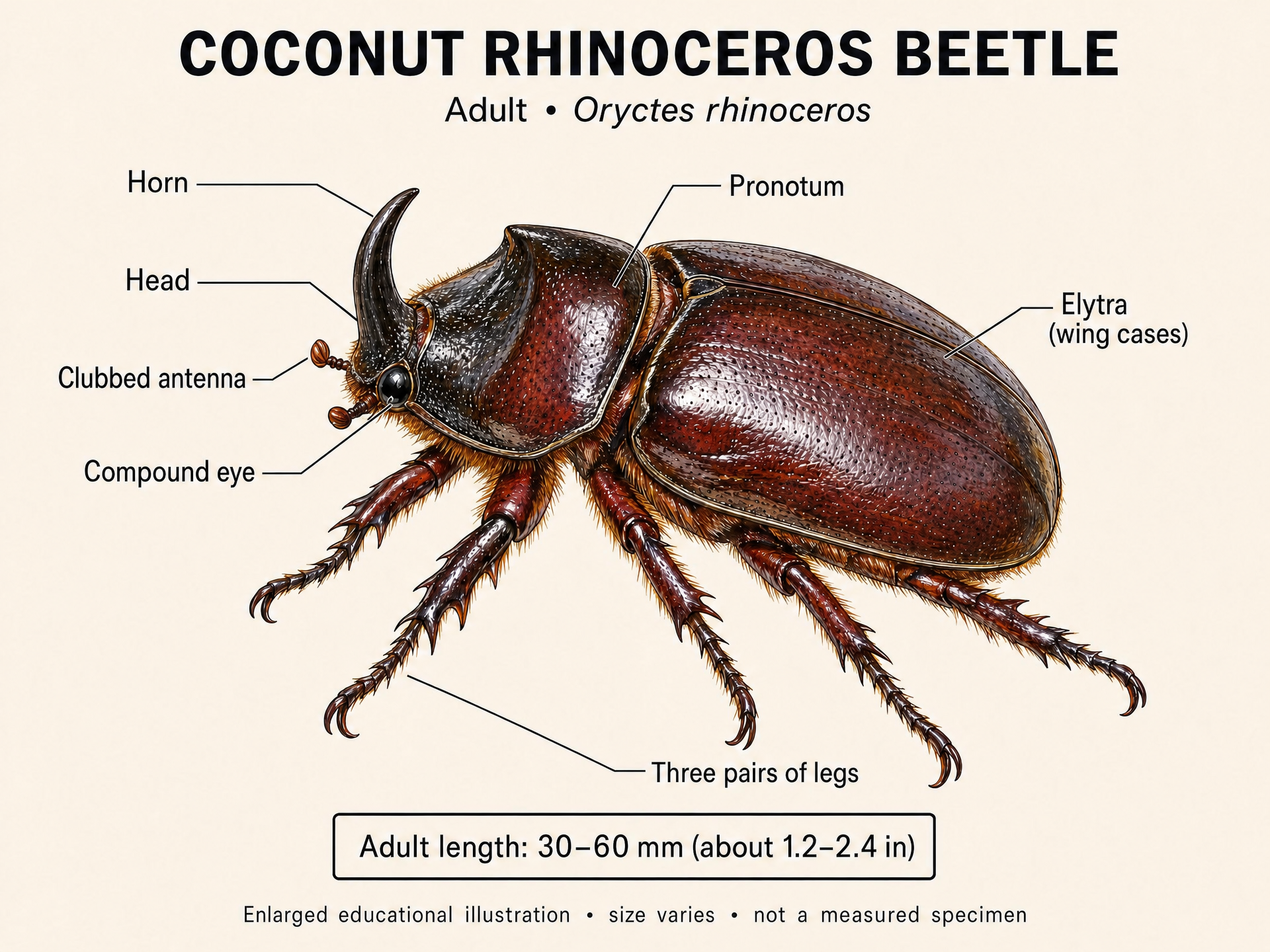
Adults leave the breeding material and feed in palm crowns. Compare several features together: the head horn, robust body, and hard wing covers.
- Parts to compare
- Head and horn; pronotum behind the head; paired elytra (wing covers); six legs.
- Size context
- Body length is commonly 30–60 mm in the SPC manual. Horn size varies, and both sexes have a horn.
Timing depends on conditions.
Temperature and the breeding material affect development. Treat life-cycle timing as context for monitoring, rather than a guarantee that a pile is free of beetles.
Sources & reading notes
Reviewed October 22, 2026. Aloha Organic summaries draw on the sources below.
A closer look at the grub.
What each part tells you.
Open a label for a plain-language explanation.
Head capsule
The reddish-brown head is more strongly hardened than the pale, soft body.
Mandibles
Paired jaws at the mouth process food from decomposing plant material.
Thoracic legs
Three pairs of short legs attach to the three body segments immediately behind the head. There are no legs along the abdomen.
Segmented abdomen
The soft rear body is divided into segments and commonly rests in a C-shaped curve.
Spiracles
Small breathing openings connect the insect’s internal air-tube system to the outside.
Darker hindgut
The gut and its contents can show through the translucent body, especially toward the rear. Color is variable and does not confirm species.
Anatomy and size reference: SPC manual, chapter 2 . Generated educational interpretations are shown beside real reference photographs.
Compare the lengths.
Adult body length is 30–60 mm. Mature larvae can reach 100 mm along the body; younger larvae are smaller.
The solid adult bar reaches 30 mm; its striped extension reaches 60 mm. Both bars share one relative scale. This graphic is not a physical on-screen ruler, and the enlarged illustrations are not to scale. Larval length follows the body, not the width of its C-shaped pose.
Source: SPC second-edition manual, printed pages 5–7. Photograph a ruler beside a real specimen when recording size; size alone does not confirm CRB.
Curved body, variable colorCurved bodies and pale or grayish coloring occur in several scarab larvae. These features alone do not confirm CRB.
Brown head, darker rearRecord a clear side and underside view. Fine structures need real specimen photographs and expert comparison.
Keep its settingPhotograph the decaying material where it was found and record movement. Use our look-alike page for a real specimen comparison.