Monitor consistently
Record palm damage and breeding-site observations before and after management, using the same assessment approach.
Manual, printed pages 14–22Aloha Organic’s reading guide to the Pacific Community’s second edition: observation, prevention, biological control, and integrated care.
A manual for management of the pest in Pacific Island countries and territories.
Sarah Mansfield, Sean Marshall, Trevor Jackson, Sulav Paudel, Laura Villamizar & Mark Ero · Pacific Community (SPC) · ISBN 978-982-00-1670-5
The complete second edition, from Aloha Organic’s document collection. Original publisher credits and terms are preserved in the PDF.
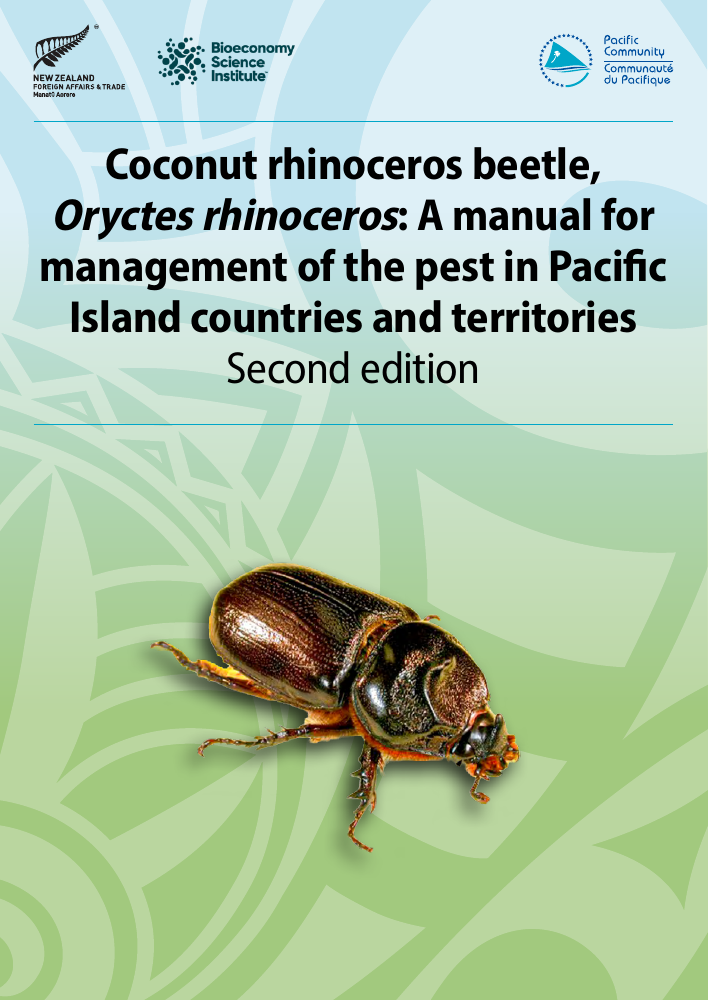
Publisher’s original cover · © SPC 2026
This manual is a foundation for learning and planning across the Pacific. Its treatment protocols depend on the crop, location, fungal strain, training, and local approvals. As reviewed October 22, 2026, CRB Response states that Metarhizium is not approved for biopesticide use in Hawaiʻi. The annexes below are regional reference protocols; they are not instructions to apply or import that organism in Hawaiʻi.
Aloha Organic’s summaries are separate from the original manual. Keep the source pages and applicable product labels with any management plan.
Record palm damage and breeding-site observations before and after management, using the same assessment approach.
Manual, printed pages 14–22Manage rotting palms and organic waste; sanitation complements all other controls.
Manual, printed pages 24–26The regional plan combines OrNV and Metarhizium with sanitation, but availability, strain effectiveness and local approvals must be established.
Manual, printed pages 26–31The manual’s IPM chapter connects monitoring, sanitation and biological control, with additional measures varying between coconut and oil palm.
Manual, printed pages 33–34Annex 5 describes Metarhizium majus on rice for CRB breeding sites. Annex 4 concerns oil palm plantations. These are distinct protocols; neither is a universal recipe for every fungal product or a Hawaiʻi treatment recommendation.
Find infested natural breeding material, discuss access and treatment locations with landowners, and record locations plus baseline photographs.
Annex 5 · printed pages 47
The manual calls for trained personnel, suitable protective equipment, quality-controlled M. majus material and weather planning that avoids heavy rain or storms.
Annex 5 · printed pages 47–48
Annex 5 describes a specific sporulated-rice approach: protect the material from heat during transport, distribute it through suitable decaying material and shield it from sunlight. Refer to the full annex for its quantities and method; these are not interchangeable commercial-label rates.
Annex 5 · printed pages 48
Keep the treatment date, site identity, fungal batch and quantity used with photographs; the manual provides recording sheets.
Annex 5 · printed pages 48–49
Annex 5 schedules three-month assessment visits, with further treatment tied to remaining breeding material or grubs. Keep this distinct from the body chapter’s general four-to-six-month discussion.
Annex 5 · printed pages 48
This is a reading guide, not a replacement for the full method. Annex 5 uses three-month assessment visits; the main chapter separately discusses four-to-six-month reapplication. Refer to the relevant section for its conditions.
The manual includes treatment recording sheets on printed page 49 (PDF page 58). Our community map and monitoring form provide a place to keep local tree observations connected.
Page numbers in the book start nine pages after the PDF begins. The reader shows both. Original text, photographs, and diagrams remain credited to the publisher.
Download the complete second-edition manual ↓
© Pacific Community 2026. Original publication supplied from Aloha Organic’s document collection. The PDF is unmodified, and its acknowledgments, image credits, and copyright notice remain intact. Aloha Organic’s reading guide is separate from SPC’s original text.
Reviewed October 22, 2026. Aloha Organic summaries draw on the sources below.